
A men’s grooming line can carry several shavers that look similar on a product page yet behave very differently against the skin. Rotary heads handle curved areas and changing beard direction well. Foil systems give a straighter cutting path and often suit users who prefer close, controlled passes. For private label buyers, the decision reaches beyond appearance. Head geometry, motor stability, blade finishing, battery behavior, waterproof construction, cleaning access, and packaging all shape reviews and return rates. Rotary and foil electric shavers should therefore be selected around a clear user profile, not simply around the lowest quotation.
Rotary and foil electric shavers solve the same grooming task through different contact patterns. That difference affects comfort, speed, noise, and how forgiving the product feels in daily use.
A rotary shaver usually uses two or three circular cutting units. Hair enters slots in the outer guard, then rotating blades cut it beneath the surface. Because each head can follow a slightly different angle, the system works naturally around the jaw, chin, and neck.
This format is useful for users whose beard grows in several directions or who shave less frequently. The trade-off is technique. Some users need time to learn small circular movements, and poor head alignment can create drag or uneven cutting.
A foil shaver uses an oscillating cutter beneath a thin perforated screen. The cutting path is linear, which makes it easier to guide along sideburns, cheeks, and other defined edges.
Foil systems often appeal to frequent shavers and users who prefer short, straight passes. They can feel precise, though the foil must remain smooth and properly tensioned. A dented screen or weak cutter contact quickly reduces performance.

The shaving head is where product quality becomes visible. A polished housing cannot compensate for a rough foil, loose rotary guard, dull cutter, or drive system that loses speed under load.
For rotary heads, inspect the slot pattern, guard smoothness, blade fit, and freedom of movement. The head should flex enough to follow the face without feeling loose. Burrs or uneven edges can scratch before they become obvious to the eye.
For foil units, check screen flatness, perforation consistency, cutter travel, and foil retention. The screen must sit close to the moving blade without contact that creates heat or noise. Replacement parts should fit without force or excess play.
A motor may sound fast with no load and still slow when cutting dense beard. That slowdown causes pulling, repeated passes, and uneven battery consumption.
Production samples should be tested on different beard densities and after partial battery discharge. Listen for a change in pitch, vibration, or intermittent stalling. The important point is not the headline motor speed; it is whether speed remains stable when the cutting head meets resistance.
Battery and cleaning complaints often arrive before blade wear becomes an issue. A shaver that cuts well but charges unpredictably, traps water, or gives confusing indicators will still disappoint customers.
Review battery type, nominal capacity, charge time, operating time, low-power behavior, and standby loss. A clear indicator should distinguish charging, full charge, and low battery. USB charging is convenient, but cable quality and port fit still need inspection.
Some buyers also ask whether the shaver can operate while plugged in. That decision affects circuitry, waterproofing, and instructions. It should be defined early rather than added after the housing and charging board are already approved.
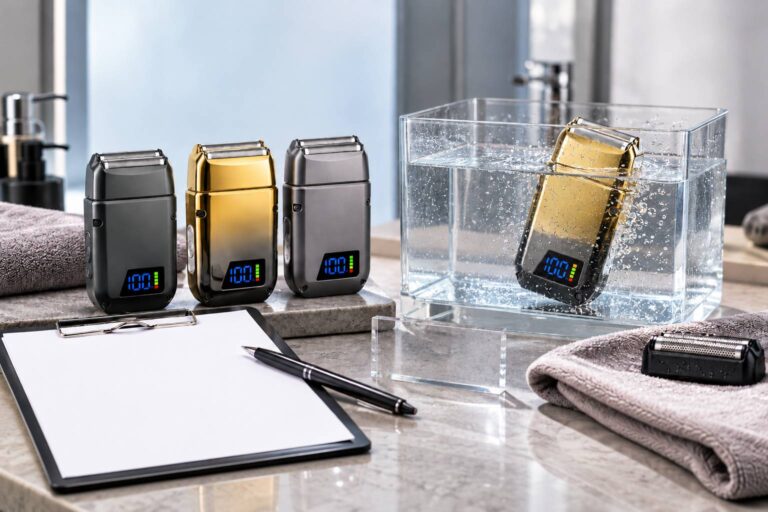
Washable can refer to the cutter head only or to the full appliance. The product manual, packaging, and markings must say which parts can be rinsed. Ambiguous language creates misuse and service disputes.
Drainage deserves a physical test. Water should leave the head and housing without collecting around the drive shaft, seals, or charging area. After repeated rinsing, inspect for corrosion, odor, reduced movement, and moisture behind transparent windows or indicator covers.
A grooming collection should feel related without forcing every product into the same shape. Rotary and foil shavers have different ergonomic needs, so visual consistency should come from details that do not weaken function.
Color palette, logo placement, charging cable, indicator language, package size, and instruction layout are sensible areas to align. Shared accessories can reduce inventory complexity, provided they fit each model properly.
Grip shape, head angle, and switch position may need to differ. A rotary shaver benefits from a form that supports circular movement, while a foil shaver often feels better with a narrower body that follows straight passes.
A travel cap, cleaning brush, pouch, charging cable, and spare cutting unit can add value, but every accessory should solve a real use case. Decorative extras increase cost and packing risk without improving the shave.
Packaging should protect the foil or rotary head from impact. It should also explain charging, cleaning, blade replacement, wet-use limits, and intended shaving technique. Clear instructions reduce complaints that are actually usage problems rather than product defects.

A sample can perform well because it was hand-adjusted. Bulk production reveals whether the factory can repeat cutter fit, motor behavior, charging, finish, and labeling across many units.
Incoming inspection should cover motors, batteries, blades, foils or rotary guards, charging boards, housings, seals, and accessories. During assembly, check head fit, switch response, charging indication, noise, vibration, and finish.
Finished-product testing should include cutting function, runtime sampling, charging, water exposure where applicable, drop resistance, package completeness, and label accuracy. Random teardown can reveal loose wiring, inconsistent soldering, poor sealing, or uneven blade assembly.
The approved specification should identify the motor, battery, cutter system, blade material, foil or guard construction, charging port, cable, seals, housing material, accessories, artwork, and packaging. A physical reference sample should carry a version date.
Changes to the motor, battery cell, cutter supplier, charging board, seal material, or head geometry should require written approval. These substitutions may leave the product looking unchanged while altering noise, runtime, comfort, or durability.
SUOKE Electric supplies home appliance products and supports private label development for rotary and foil electric shavers. A buyer can provide the target user, shaving system, head layout, battery expectations, charging interface, wet-use requirement, color direction, accessories, packaging, order quantity, and launch schedule. Project review should define cutter construction, motor behavior, blade fit, housing materials, indicator logic, cleaning method, sample approval, and inspection criteria. Before mass production, both parties should approve the physical sample, component list, artwork, instructions, packaging method, batch identification, and written change-notification requirements so repeat orders remain tied to the same approved product configuration for receiving inspection.
Rotary and foil electric shavers belong in different positions within a private label men’s grooming line. Rotary models suit curved areas and varied beard direction, while foil models offer a more linear, controlled shave. Buyers should evaluate the complete system: head geometry, blade finishing, motor stability, battery behavior, waterproofing, cleaning, and production control. A clear user profile and a locked component specification make the product easier to position, inspect, and reorder without unexpected performance changes.
Both rotary and foil electric shavers can work. Skin comfort depends on guard smoothness, blade sharpness, motor stability, shaving pressure, beard length, and cleaning condition rather than system type alone.
Rotary shavers often handle curved areas and changing growth direction more easily. Dense beard still requires stable motor torque, sharp cutters, and a head design that feeds hair efficiently.
Yes. Branding, colors, instructions, and accessories can be coordinated, but internal supports must match each head shape and protect delicate foils or rotary guards during shipment.
Test cutting comfort, pulling, motor slowdown, noise, vibration, runtime, charging, indicators, cleaning, water resistance where applicable, head retention, accessory fit, packaging, and repeatability across several units.
Control the motor, battery, blade system, foil or rotary guard, charging board, seals, housing, cable, indicators, accessories, artwork, and packaging through approved specifications and change notification.