


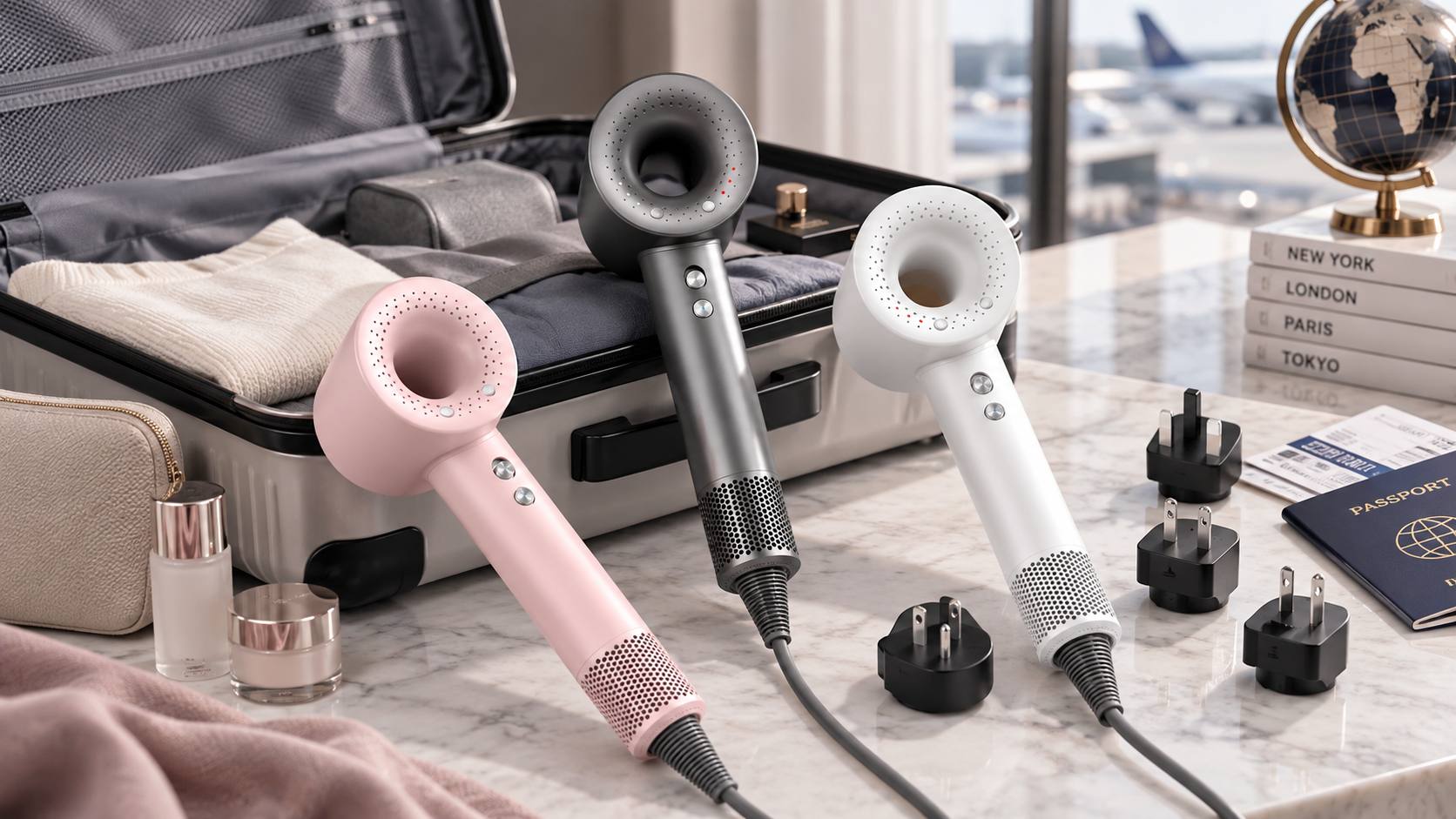
A hair dryer can perform well in a sample room and still be unsuitable for the country where it will be sold. Voltage, frequency, rated power, plug configuration, cord construction, product marking, and the information printed on the box all need to match the destination market and the exact electrical configuration being supplied. For importers and private label brands, this makes market adaptation an early engineering and purchasing decision, not a packaging detail to solve shortly before shipment. The practical objective is simple: define the target market first, verify the electrical version that will actually be produced, and prevent artwork or accessories from being approved against a different configuration.
Hair dryers draw substantially more power than many small rechargeable grooming devices, so electrical configuration cannot be treated as interchangeable simply because two housings look identical. A supplier may offer several versions of the same basic design, but the correct version has to be tied to the country where the product will be sold.
The first RFQ should therefore identify the destination market rather than only the requested color, motor type, or appearance.
Logo position, housing finish, attachments, and carton graphics can usually be adjusted later in development. Electrical configuration needs earlier agreement because it can influence internal components, cord and plug selection, rating labels, testing, and documentation.
Before sampling, the purchasing team should request the model-specific rated input data and compare it with its intended market requirements. Do not assume that a dryer described as “international” or “travel-friendly” automatically supports every supply system.
The available hair dryer category can be used to identify the current product direction, but the electrical data for the selected model still needs to be confirmed from the final specification and approved sample.
Once the correct market version has been identified, the sample should be checked as a complete electrical product rather than as a styling appliance with a plug attached at the end.
Rated voltage, frequency, power, cord, plug, switches, markings, and supplied accessories should correspond with the documents used for the project.
| Item to Check | What Needs to Match | Common Purchasing Risk |
|---|---|---|
| Rated input | Final approved specification | Wrong electrical version ordered |
| Plug | Destination market configuration | Repacking or replacement before sale |
| Cord | Approved sample and requirement | Mismatch with final configuration |
| Product label | Actual electrical version | Incorrect consumer information |
| Carton/manual | Same data as the product | Artwork left from another version |
The important point is consistency. If the dryer body shows one electrical version while the manual or carton shows another, the product has a documentation problem even before performance is considered.
A sample fitted with a temporary adapter is not the same as a production sample with the final cord and plug arrangement. Purchasing teams should insist that final approval reflects the actual market configuration that will be packed in the order.
This also makes ergonomic review more realistic. Cord position, strain relief, plug size, and storage all affect the complete product even though they receive less attention than airflow or styling attachments.
Multi-market projects become complicated when one dryer platform is sold with several plug versions. The housing may remain similar, while the electrical configuration and printed material differ from region to region.
That creates a version-control problem.
A practical solution is to identify every configuration with a clear internal reference before production. The reference should connect the dryer, cord, plug, rating label, manual, packaging, and carton mark belonging to that market.
Private label teams often develop packaging while samples are still changing. That is efficient until one market version is updated and the artwork is not.
If the project contains several plug types, the approval file should make it difficult to mix them. Product images may be shared, but electrical information should never be copied automatically between versions.
The same discipline applies to user manuals. A manual written around another market’s configuration can create confusion even when the dryer itself has been assembled correctly.
When reviewing the supplier’s production and inspection workflow, importers can ask specifically how different market versions are identified on the line and during packing.
Packaging approval needs to happen against the final electrical configuration. This is particularly important when the same housing is being sold into several regions because artwork can make different variants appear interchangeable when they are not.
The buyer should compare the product rating information, carton text, manual, plug version, and order documents side by side.
Compliance documents should also correspond to the exact configuration being purchased. A report or certificate referring to another model, adapter, cord set, or market should not automatically be treated as evidence for the current order.
Words such as “universal,” “global,” or “all-market” can create trouble when they are used more broadly than the verified product configuration permits.
A safer procurement approach is to state only what has been confirmed for the selected model and destination.
If documentation is incomplete, the gap should be resolved before artwork is printed in volume. Correcting a digital file is considerably easier than relabeling finished stock that has already been packed.

The final production release needs to remove ambiguity. A buyer who approves only the housing color and general product appearance leaves too many electrical details open to interpretation.
The approved reference should include the destination market, rated electrical configuration, plug, cord, product marking, manual, packaging, attachments, and inspection points.
For projects with more than one market version, the release sheet should also show how each variant is identified.
A useful final check is to place one complete retail set from each market version on a table and compare it against the purchase order. The team can verify the dryer, plug, label, instructions, attachments, and carton in a few minutes and catch mismatches that are harder to notice when documents are reviewed separately.
The same references should remain available for repeat orders. If a cord, plug, internal electrical component, or label changes later, the update should be reviewed before the factory substitutes it.
SUOKE Electric supplies personal care electrical appliances for overseas retail, distribution, and OEM/ODM projects. For hair dryer sourcing, the company can support buyers with product selection, private label customization, packaging coordination, production inspection, and shipment preparation for different market requirements. Its current hair dryer range includes high-speed styling models suitable for further project evaluation. Buyers can confirm target-market requirements, branding, packaging, labeling, and production details with the team before bulk ordering, then submit project information through the contact page.
Market adaptation for a hair dryer starts with the electrical version, not with the carton design. Importers need to define the destination first, verify rated input information on the actual sample, and keep the plug, cord, label, manual, packaging, and compliance files tied to that same configuration. Multi-market programs require especially clear version control because visually similar products can contain different electrical arrangements. Before releasing production, one complete retail set for every market version should be checked against the final order documents.
Not necessarily. Electrical supply conditions, plug configurations, labeling, and compliance requirements differ between markets. The exact version being supplied needs to be checked against the destination country before the buyer approves production.
A plug adapter only changes the physical connection. It does not prove that the dryer’s rated electrical configuration is suitable for another supply system. The product specification must be verified separately.
It should be identified during the early sourcing stage and physically confirmed on the production-intent sample before packaging is finalized. Leaving the plug decision until the end increases the risk of artwork, manual, or packing mismatches.
Separate references help prevent the wrong plug, label, manual, or carton from being packed with a visually similar dryer. They are particularly useful when several regional variants are produced in the same period.
At minimum, the supplier needs the destination market, intended sales channel, required product configuration, branding and packaging direction, expected quantity, and any market-specific documentation requirements that the importer already knows.