
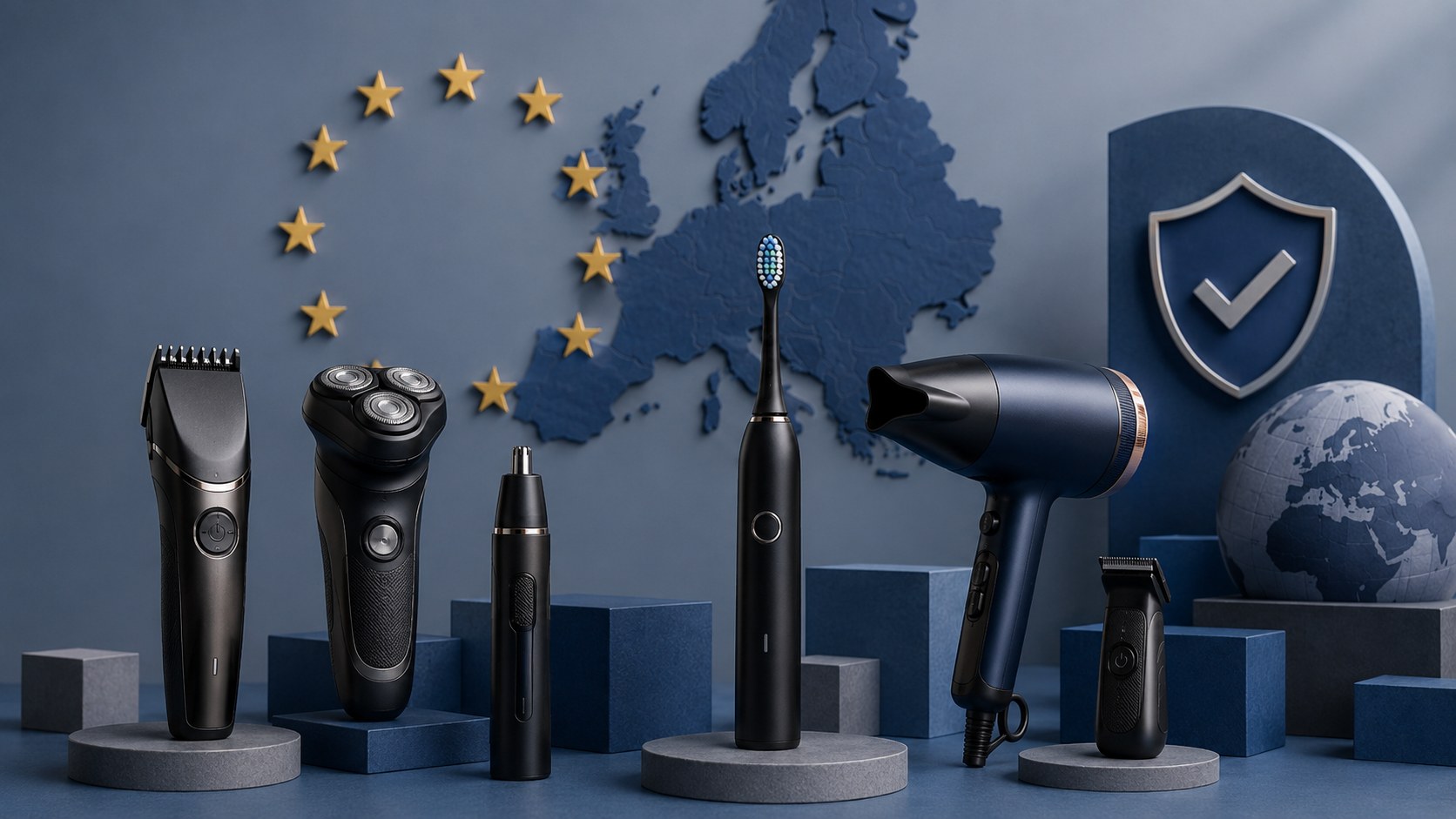
The European Union’s General Product Safety Regulation (GPSR) which will be fully implemented by 2026 is one of the most far reaching changes to laws on consumer protection in recent years. The GPSR replaces the 20 year old General Product Safety Directive (GPSD) and contains a number of key changes including placing a greater burden of obligation on the manufacturers, importers and distributors of products. For retailers of hair grooming products, specifically electric shavers, hair trimmers and hair and skin care devices, implementation of the GPSR is not simply a case of completing additional paperwork in order to comply with the legislation in order to be able to sell their products in EU countries. It is also important for them in terms of protecting their brand, ensuring that they continue to be able to sell their products in the countries of the EU and managing the ways in which they manage to safely protect their consumers.
The transition from GPSD to GPSR has major consequences for the design, documentation and sales of cosmetic products on the European market.
The new regulation expands product safety obligations beyond physical retail to include online marketplaces and digital platforms. Manufacturers must now provide consumers with digital access to user manuals and safety information through accessible channels such as QR codes or online portals. Another major change lies in traceability: brands are required to document every stage of their supply chain—from raw material sourcing to final distribution—ensuring that each product batch can be traced back quickly in case of a recall or defect investigation.
Rechargeable electric shavers and other electric grooming tools are classified as connected or smart consumer products if they contain electronic components and/or a battery. Non-electric grooming tools, for example traditional razors and combs, are subject to general safety requirements. Also accessories such as charging cables and removable parts of grooming tools, like shaving heads, must comply with labeling requirements and have to be tested for conformity before they can be placed on the market in the EU. The EU safety regulation for consumer products therefore takes a holistic view and requires all components of a product to meet the same safety requirements in order to guarantee the required level of safety for the user.
A systematic approach to navigate through regulatory requirements is required. It is essential for manufacturers of grooming products to have a plan that involves interpretation of laws and their implementation.
First a gap analysis has to be done between the GPSR text and the existing internal processes. Based on the identified gaps the technical documentation has to be completed with a detailed risk analysis and a declaration of conformity for each single model. In addition a traceability has to be implemented to be able to record supplier data, batch numbers and production dates, often by using the existing ERP software of a company in real time.
Digitalization is key to the execution of compliance by brands. In the first place QR-codes on labels can be linked to safety information in all languages online. The latter can then easily be updated without having to reprint packaging materials. In case of a recall or update brands can manage the information in a database that is accessible in all EU languages. This enables them to fulfill their transparency obligation in a timely manner and to avoid delays in administrative procedures in case of an inspection or investigation. Also online content has to be made accessible for people with disabilities according to the rules of EU consumer law.
Post-market surveillance (PMS) – formerly a task completed post-launch – is to be transformed into an on-going task and become a permanent monitoring task.
Manufacturers must monitor customer feedback, warranty claims and reported incidents in a structured data collection system. Service centers play a significant role in this. Issues that occur again and again, for example overheating or a battery that suddenly fails, can be signs of a design error that needs to be rectified quickly. According to the European Commission’s 2023 report on product recalls in the EU, the majority of recalls of electrical grooming devices were due to overheating. Monitoring these types of issues is therefore crucial to prevent a larger safety issue affecting consumers from occurring.
Recall activity should be managed by an internal reporting system corresponding to RAPEX, the rapid alert system for products posing a danger for consumers on the internal market. The recall must be coordinated between distributors and online retail shops in order to keep the time frame of the consumer’s exposure as low as possible as for new products. All measures taken for correction of a detected deficiency have to be documented and proven during the audits in order to be able to prove the corresponding action of the responsible company in an adequate manner. From another side, such documentation is also an important component of the credibility of a brand. It shows a transparent handling of problems.
In addition to potential damage to a company’s reputation, the financial consequences of failure to comply with requirements could lead to serious problems for a company’s business in the EU markets.
Severe violations may trigger fines reaching up to €10 million or 4% of annual turnover—whichever is higher—depending on national enforcement mechanisms across member states. Delays in obtaining necessary certifications could also halt distribution activities temporarily, leading to revenue disruptions and potential contract losses with retail partners who demand proof of compliance prior to listing products online or in stores.
Early adopters often experience tangible benefits beyond regulatory peace of mind: improved retailer trust, smoother audits, and reduced administrative overhead thanks to standardized documentation practices. Transparent compliance records also attract investors seeking evidence of sustainable governance practices—a growing priority within ESG-focused portfolios across Europe’s manufacturing sectors. Over time, these advantages collectively deliver stronger returns on investment compared with reactive compliance strategies implemented only after enforcement begins in full force by 2026.

No single manufacturer can successfully navigate the regulatory environment alone. Collaboration throughout the entire supply chain is key to success.
Article 9 of the GPSR framework places all economic operators —importers and distributors, as well as retailers — equally responsible for conformity before goods are supplied to consumers. Importers have the responsibility to check for the CE marking and to hold a copy of the conformity declaration provided by the manufacturer when placing the goods on the market. While sharing the responsibility for ensuring conformity and thus reducing potential “blind spots” created by distributors and retailers, such a model requires good communication by all parties concerned for changes in test results and for relabeling as a result of changed risk assessments.
An efficient traceability system integrated into an ERP system can display and monitor all processes and stages of a product on the fly, from raw material suppliers through production lines to retail stores. Conducting regular audits of suppliers to verify their Material Safety Data Sheets (MSDS) and laboratory test reports issued by recognized bodies, such as TÜV Rheinland and SGS Group, helps to guarantee compliance with all applicable regulations at all production stages. A mid-sized chain-store cosmetics manufacturer was able to reduce the time it took to prepare for an audit by 40% after introducing serialized tracking codes into its quality management system database, thereby increasing efficiency and ensuring accountability in real time.
As the enforcement timelines for the stricter rules for grooming products are getting closer, working with an experienced partner for production becomes a matter of operational advantage rather than advertising slogan. SUOKE Electric already long time ago set up its production system in accordance with EU stipulations, i.e. before even the transition to GPSD started. Production can be set up in a way to be as traceable as required for the clients. This already during production, not as an add-on later on. The Chinese manufacturer of electric grooming tools for dogs is offering OEM/ODM production of pet grooming tools, all of them being labeled in several languages, also tested according to EN 60335 for electrical appliances. This is exactly what is needed for GPSR conformity. And even more: the production workflow itself is already set up in a way to feature traceability, all this at competitive prices and with the necessary reliability.
The upcoming enforcement phase of EU GPSR 2026 will present every manufacturer of grooming products within Europe as well as on the markets of third countries exporting to Europe with new challenges. Manufacturers who take the time to get their documentation and the provision of information about their products in order on a digital basis, who make sure that their staff is adequately trained for the post-market surveillance activities, and who also work on a sound basis with their suppliers, will not only avoid unnecessary financial losses due to fines and penalties but also earn the trust of the market surveillance authorities and the end consumers in the long term. Proactive compliance will become a major success factor for companies in the long term and will make them immune to changes in the safety expectations of goods in global supply chains which are currently driven by transparency.
The regulation becomes effective on 13 Dec 2024. The full impact of the regulation, however, as measures for enforcement including penalties become more intense, will be felt only by 2026 as transitional measures complete.
This includes both electric as well as non-electric grooming products such as for instance hair trimmers and shavers as well as safety razors and other razor types which are offered on the EU market.
Manufacturers must maintain technical files including risk assessments, conformity declarations, traceability logs, and accessible digital manuals.
Partner with suppliers who already fulfill necessary testing, or use joint certifications offered by industry associations through a shared platform.
Noncompliance with GPSR can have severe consequences for a company such as payment of heavy fines, recalls, withdrawal from online trade platforms or even a ban to offer goods and services in all other EU member states until appropriate measures have been taken.