


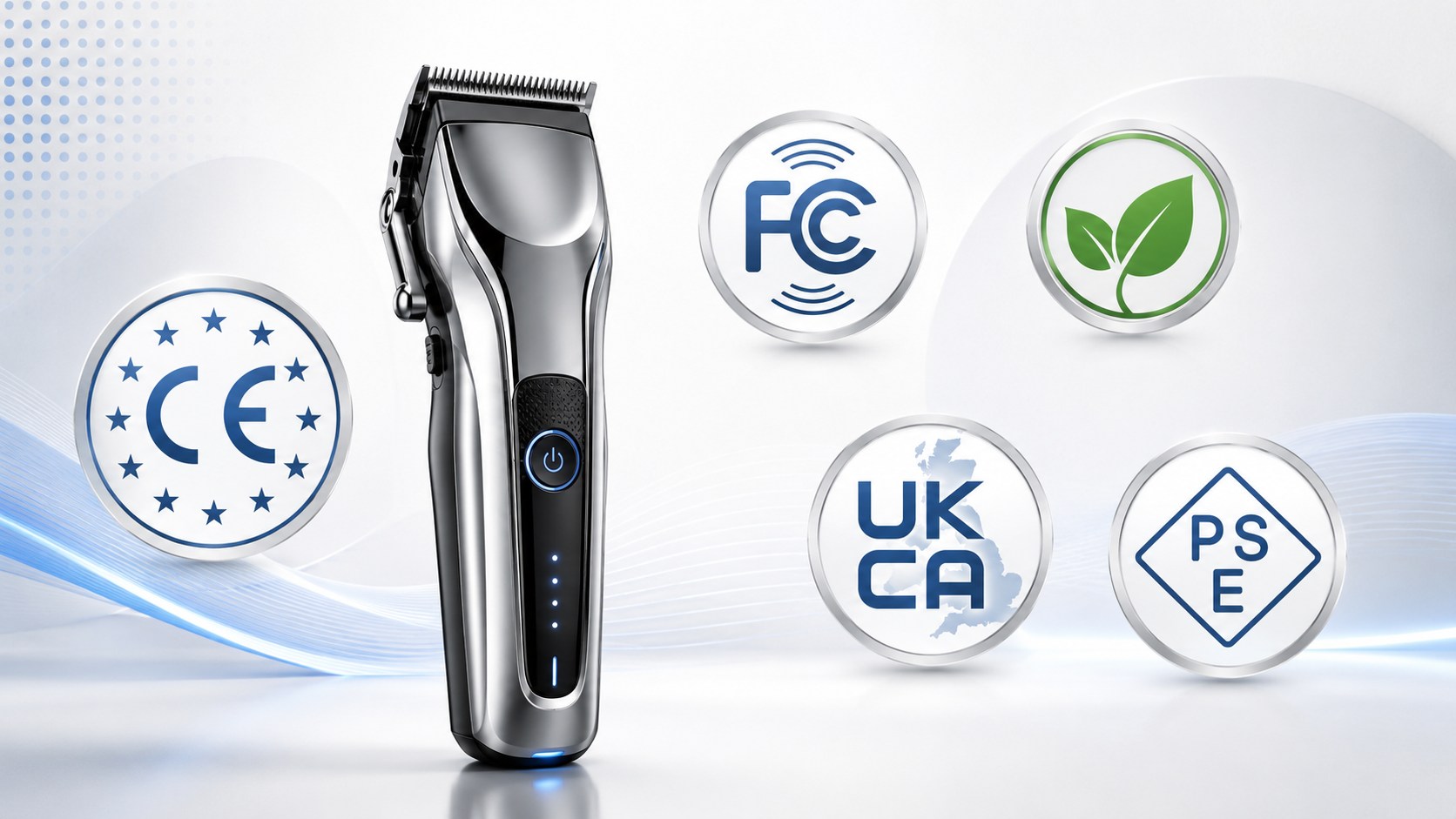
For importers, private-label brands, wholesalers, salons, and retail buyers, hair clipper certifications are not decoration on a box. They affect market access, customs review, platform approval, retailer onboarding, product safety, documentation, and after-sales risk. A CE certified hair clipper for Europe, FCC grooming products for the United States, and PSE certification Japan requirements may involve different rules, tests, labels, and responsible parties. Buyers should not ask only whether a supplier “has certificates.” They should check which product model, charger, battery, packaging, and market the documents actually cover.
Buyers use Certifications and compliance documents to reduce the risk of getting back shipments that were not accepted by customers, getting held up at borders due to unsafe products, being sold with misleading labels or unsupported sales claims. It’s also important to separate out Product Certification from test reports and supplier self-declarations.
A hair clipper is usually an electrical grooming appliance. Cordless models may include batteries, chargers, motors, PCB boards, and radio-frequency or EMC-related components. If documents are missing or mismatched, importers may face customs delays, platform removals, retailer rejection, or costly relabeling.
Experienced buyers like to check the information of the goods before placing big order, like model no, rated voltage, charger, battery specs, user manual, label, test report etc.
Every region has its own rules. A EU compliance document does not automatically also prove compliance in US, UK or Japan. Also within a product family different adapters, batteries, motors or PCBs often require a separate document review.
A practical buyer should match the certificate to the exact SKU, not only the brand name or product photo.
CE marking is one of the most asked for requirements by buyers. It is a legal conformity marking and not a general quality mark.
CE marking indicates that products sold in the European Economic Area have been assessed to meet high safety, health, environmental protection requirements. The assessment and the resulting technical file, EU Declaration of Conformity and affixing of the CE mark are the manufacturer’s responsibility.
When purchasing a CE certified hair clipper the buyer needs the following documents: Declaration of Conformity, the applicable directives, the used standards, the test reports, the model list and the label artwork.
Buyers need to check whether the file includes all relevant information regarding the hair clipper, charger, battery pack, packaging and the target market. If any changes to the product under test occur after the file has been used for testing, the file may require revising as well.
CE marking can include requirements such as safety, EMC as well as RoHS and other relevant requirements. A supplier’s statement alone is not enough to consider it sufficient for a technical file or to check compliance for a specific market.
These marks and rules indicate different risks. Therefore, as a buyer, you must know what risk a mark or rule indicates before you can compare suppliers.
FCC rules require that radio-frequency equipment be authorized before it is marketed or brought into the United States. FCC equipment authorization can be granted by Supplier’s Declaration of Conformity or Certification.
Some of the typical questions for Grooming / Beauty products with chargers, digital controls, wireless functions, RF emissions, etc. are: Is SDoC or Certification required for this product? Who is the U.S. responsible party.
EU RoHS aims at restricting hazardous substances for human health and for the environment in electrical and electronic equipment. The list of restricted substances is published by the European Commission, including lead, mercury, cadmium, hexavalent chromium, PBB, PBDE as well as several phthalates.
This item is hair clippers. Items which we review for compliance with RoHS are the PCB board, solder, motor, wires, plastic parts, batteries, and chargers for this product. The RoHS report must cover the exact components which we tested for this specific model.
The UK government has described the meaning of UKCA and CE marking on products to sale in Great Britain. The UK will continue to also recognize CE marking on products and from 2024 this may be used in place of UKCA marking on many product types.
Further details for the specific product category, destination, labeling plan, Declaration of Conformity and importer obligations should be verified as these are subject to change and do not necessarily mirror the corresponding EU requirements exactly.
Japan’s METI explains that the Electrical Appliances and Materials Safety Act regulates the manufacture, import, and sale of designated electrical appliances and materials to prevent hazards and disturbances. Importers have obligations, including business notification, technical compliance, self-inspection records, and PSE labeling where applicable.
For PSE certification Japan projects, the following components need to be checked if they fall within the scope: hair clippers, AC adapter, charger, and battery related parts.
The level of compliance required will typically vary between sales channels, thus a small online test order is likely to present less risk than a national launch via retail stores.
In order to list your products on marketplaces such as Amazon, eBay or Rakuten, sellers generally require product photos, product labels, user manuals, test reports, battery details and warning notices. Additionally, any claims made about a product, such as waterproof, child safe, salon quality, CE certified etc. must be supported by the relevant documents and physical samples.
A practical launch should include packaging review before shipment. If the mark, importer name, or voltage information is wrong, relabeling can delay sales.
Comments for Wholesale buyers and salon brands – these people will use the clippers more so a more indepth durability review would be appreciated. Comments for the following would be great: Blade heat, Runtime, Charging cycles, Noise, Vibration, Waterproof, How to clean, Spare blades etc.
For professional distribution channels, approval of documents is only one step in the process. Performance of the product as well as after sales service are more important.
When discussing suppliers you should consider product development, relevant documentation and ordering process. Low price does not excuse weak compliance support.
A useful checklist may include:
| Item to check | Why it matters |
|---|---|
| Product specification | Confirms voltage, power, battery, motor |
| Test reports | Links claims to tested model |
| Declaration of Conformity | Supports CE or UKCA file |
| FCC file | Supports U.S. electronic device review |
| RoHS report | Reviews restricted substances |
| PSE documents | Supports Japan market planning |
| Label and manual files | Reduces shipment and retail risk |
Look out for the following indicators of fake documentation: certificates with different model numbers; old, unclear documentation; missing information about the included charger; vague references to “global certification” without any supporting documentation; no responsible person specified. Be wary of suppliers who cannot clarify the impact of changes to components such as the battery, adapter, motor or PCB on the documentation provided.
Before we start the mass production, the buyer has to approve the sample, the labels, the manual, the carton and the test-report scope.
SUOKE Electric is introduced on their website as B2B OEM/ODM supplier for high-quality home appliances. The website lists a variety of professional hair clippers and pet hair groomers as well as other electric shaver and hair grooming appliances. The public website outlines private-label support, custom colors, custom packaging as well as various testing for compliance to CE, RoHS, FCC etc. as well as other market requirements such as PSE certification for Japan. The supplier profile may be used to compare samples, product design, packaging and labeling as well as discuss production as OEM/ODM supplier for buyers looking for hair clipper projects CE certified or FCC certified grooming appliances or other market-specific documentation. As always, all details should be compared in detail including specifications, test documents, price, delivery terms and service before placing final order.
When evaluating hair clipper certifications it is important to consider the market, model number, individual component and the sales channel. The following certifications: CE, FCC, RoHS, UKCA and PSE are not interchangeable and typically one document will not cover all countries. It is also important to clearly define legal markings, test reports, Declarations of Conformity, product labels and supplier self-declarations. A safe sourcing process includes reviewing samples, chargers, batteries, instruction manuals, packaging and a sample compliance file prior to kick off into mass production. Building a compliant product line of grooming products requires careful planning of all documentation prior to adding labels to products as last minute changes can cause costly delays.
No. CE is a No. for the European Economic Area / EU and other documents / labels are required for other markets.
No. Some products require Supplier’s Declaration of Conformity whereas others may require FCC Certification depending on the type of device.
A. No. RoHS focuses on restricted substances in electrical and electronic equipment. This is different from electrical safety testing.
No not all. CE marking for many products are recognized in Great Britain but need to be checked by individual product.
A PSE review is required if the hair clipper, charger, adapter or other related electrical components fall under Japan’s Electrical Appliances and Materials Safety Act.