

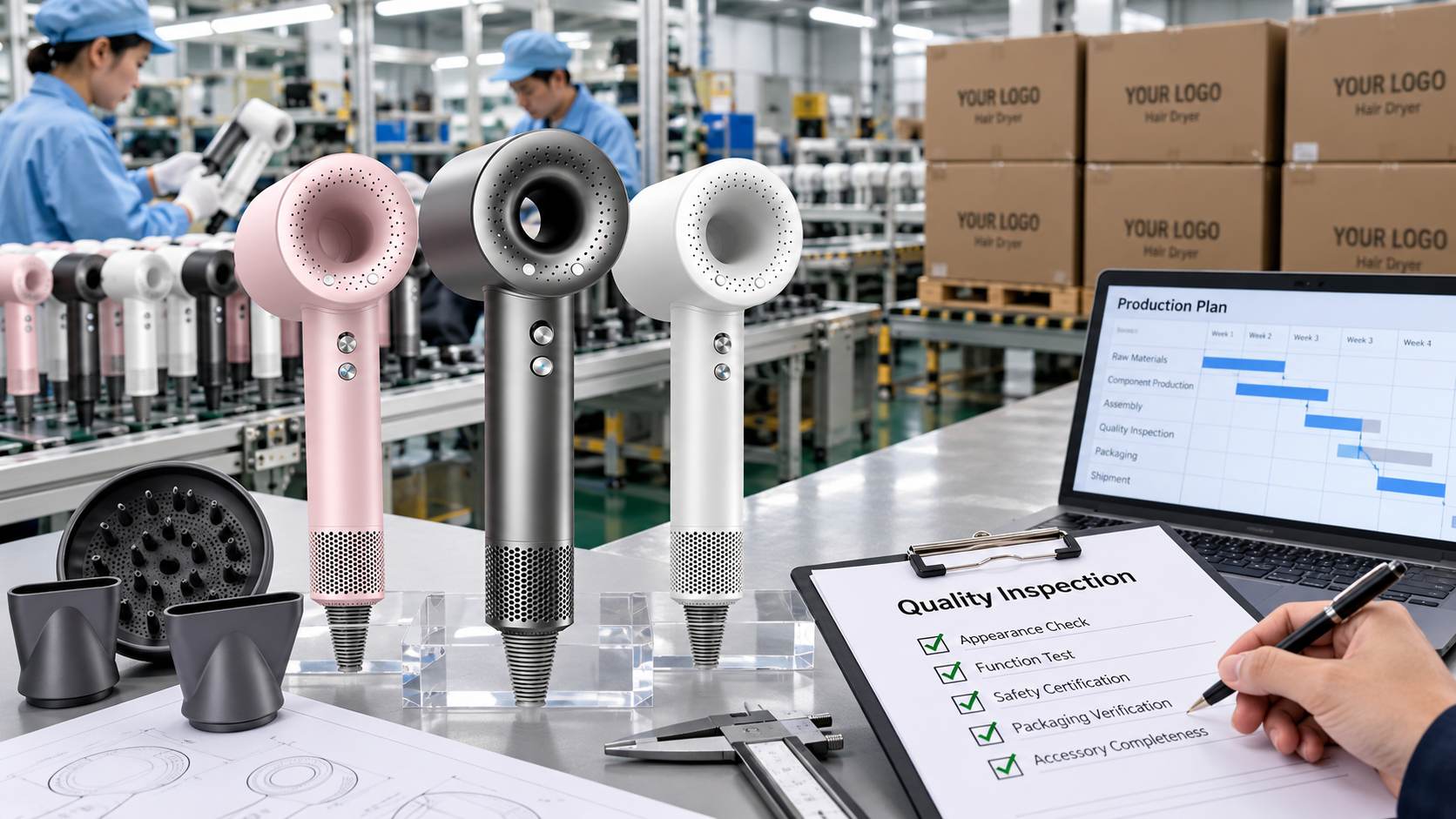
Hair dryer lead time is rarely lost in one dramatic production delay. More often, several small decisions arrive late: the sample is approved but the plug version is still open, packaging artwork changes after components have been booked, or a buyer adds a second market just as production is being scheduled. For private label buyers, that means lead-time control starts well before the factory begins assembly. A realistic schedule has to include product confirmation, market-specific details, packaging, production booking, inspection, and shipment preparation. The most useful way to shorten the project is not to push every stage faster, but to remove the decisions that force the supplier to stop, reopen files, or change materials halfway through the order.
The first delay often appears before mass production has technically started.
A buyer may receive a sample, approve its general appearance, and assume the project is ready. Meanwhile, several details are still being discussed by email: logo position, attachments, carton dimensions, plug version, manual language, or the final quantity split between markets.
From the buyer’s side, these can feel like small finishing points. From the production side, they may determine which components are ordered and which packaging files are released.
The safest approach is to separate three groups of information early:
A housing color may be flexible for a few more days. A market-specific electrical configuration or customized carton normally has more influence on the production plan.
This distinction helps purchasing teams avoid a familiar situation: everyone believes the order is moving, but the supplier is waiting for one decision that has not been treated as urgent.
The same issue appears when quotation discussions continue after the purchase order. If every commercial change requires the technical configuration to be reopened, the calendar becomes difficult to protect.
Not every approval carries the same timing risk.
For a private label hair dryer, the schedule becomes more sensitive when the buyer is changing several elements at once. A standard product with a logo and simple carton usually creates fewer coordination points than a project involving several market versions, custom colors, accessory combinations, and new packaging.
Packaging is a common bottleneck because it depends on information from more than one team.
The designer may be waiting for final product dimensions. The purchasing team may still be confirming accessories. The compliance team may be reviewing required wording. The supplier cannot safely print thousands of cartons until those details agree.
It is tempting to finish the physical sample first and leave the carton until later. That works only when the packaging is simple and unlikely to change.
For a branded retail product, artwork can affect:
If any of these change after printing, the buyer may face reprinting or manual correction.
A better schedule puts artwork review alongside product confirmation rather than after it. The two streams can move at the same time, provided the buyer knows which product details are already stable enough to use.

A buyer ordering one hair dryer for several countries may see it as one project. Production teams often see several related versions.
The housing may be shared, but plug configuration, labels, manuals, carton wording, and packing marks can differ. If those versions are not separated clearly, the project can lose time simply because nobody is certain which file belongs to which SKU.
The problem gets worse when the final quantity split keeps changing.
A purchase plan may begin with 5,000 units for one market, then become three smaller versions for different regions. That change can affect component allocation and packaging preparation even if the basic dryer stays the same.
A simple version table is often enough:
| Version | Market | Key Difference | Status |
|---|---|---|---|
| A | Market 1 | Plug / artwork set A | Approved |
| B | Market 2 | Plug / artwork set B | Artwork pending |
| C | Market 3 | Manual / label set C | Quantity pending |
The table is not complicated, but it prevents a buyer from saying “the hair dryer is approved” when only one of three versions is actually ready.
For sourcing teams, that visibility is more useful than repeatedly asking the factory for an updated lead time. The supplier can only give a meaningful schedule when the final production versions are clear.
Late changes are not automatically bad. Sometimes they are necessary.
The problem is that buyers often judge a change by how small it looks rather than by how much production work it affects.
Moving a logo by a few millimeters may be easy. Changing a color after material preparation may not be. Adding another attachment can alter the insert or carton. Changing the quantity split between market versions can affect components already allocated to the order.
Before approving a late revision, the useful question is:
What has already been purchased, printed, assembled, or booked against the current version?
That question gives the buyer a better view of the schedule impact.
If packaging has not been printed, an artwork revision may be manageable. If finished cartons are already waiting at the factory, the same request has a different cost and timing effect.
This is also where internal buyer discipline matters. When product, marketing, and sales teams send separate requests to the supplier, the factory may receive several conflicting “final” versions.
One nominated approval owner can prevent that. The role does not need to control every decision, but somebody should be responsible for confirming which revision is the current one.
A second order should usually be easier than the first, but only if the first project created a usable reference.
If the buyer has to rediscover the final color, carton file, accessory set, and market configuration every time, much of the first-order work is repeated.
The most valuable record is not a long report. It is a clean set of final production references.
That might include:
When those references remain valid, the repeat order can move more quickly because fewer questions have to be reopened.
A reorder should not become an automatic copy-and-paste process.
Component availability, packaging material, or production methods may have changed since the previous shipment. The buyer needs to know whether any change affects the approved product.
The useful approach is to ask the supplier to identify differences from the previous version before production begins. If nothing important has changed, the order can move forward quickly. If something has changed, only that point needs to be reviewed rather than rebuilding the whole project.
That is how repeat orders become faster without becoming less controlled.
SUOKE Electric supports overseas retail, distribution, and private label appliance projects with product selection, customization, production coordination, inspection, packaging, and shipment preparation. Buyers developing a hair dryer line can review the company’s hair dryer range and use its OEM/ODM support to align branding, packaging, product configuration, and production requirements before volume manufacturing. The company’s service process also covers production and quality-control stages, giving purchasing teams a clearer point for managing approvals and shipment preparation. Project quantities, target markets, and required customization can be submitted through the contact page before an order schedule is finalized.
Hair dryer lead-time risk is easier to control when buyers focus on unresolved decisions rather than simply asking the factory to work faster. Product versions, artwork, market requirements, late revisions, and repeat-order references all affect whether production can move without interruption. The strongest schedule is usually the one with fewer open questions once materials and packaging are being prepared. Before placing a bulk order, purchasing teams should know exactly which items are final, who owns approval, and what would have to change if the project scope moves.
Artwork should move in parallel with product confirmation rather than waiting until the end. Printing should begin only after the information that appears on the carton, manual, and labels is stable.
Yes, but each version needs a clear reference for plug, label, manual, packaging, quantity, and other market-specific details. Treating all versions as one generic SKU can create avoidable confusion.
The visual change may be small while the production impact is larger. A revision can affect purchased materials, printed packaging, assembly planning, or components that have already been allocated.
Keep the approved sample, SKU configuration, artwork, accessory list, and inspection requirements from the previous shipment. Then review only the items that have actually changed.
The supplier needs a defined product version, quantity, market split, customization requirements, packaging status, and expected shipment timing. A schedule based on incomplete information is likely to change later.